
Platinum is a common choice for wedding bands and engagement rings, and after a few years of wear it is easy to mix up with white gold or even silver. If you are thinking about selling or pawning a white metal ring, the first job is to find out what it is made of. The second is to understand how a buyer will put a number on it.
This guide covers the stamp, the other clues that separate platinum from white gold and silver, how a platinum ring is valued, and whether to sell or pawn it.
Start With the Stamp Inside the Band
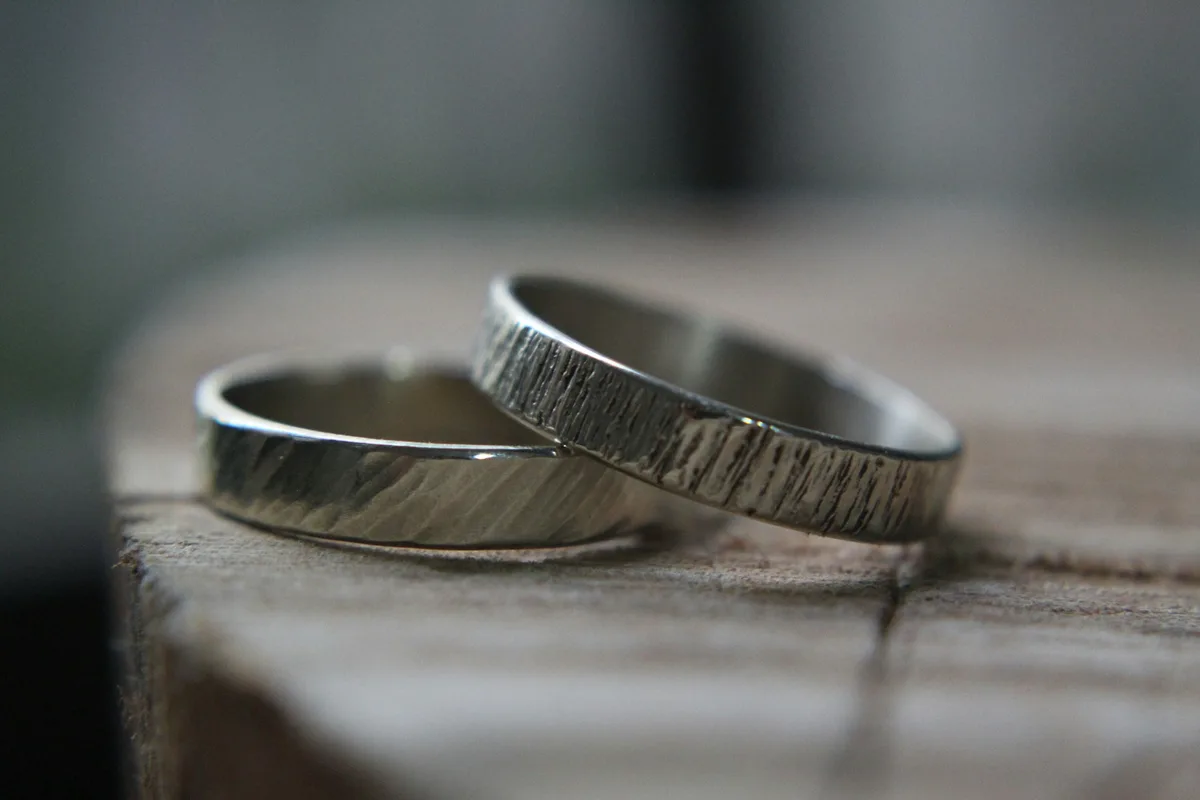
Look inside the band, with a magnifying glass if you have one. A platinum ring is usually marked “PT” or “PLAT,” often with a number such as 950 or 900. GIA’s guide to white metals explains that the abbreviation is followed by “a number describing how many parts per thousand of the alloy is platinum,” so Pt950 means 950 parts of platinum per thousand.
| Stamp | What it means | Precious metal content |
|---|---|---|
| PT, PLAT or PLATINUM with no number | Platinum | At least 950 parts per thousand platinum (95%) |
| 950 PT, 950 PLAT or PT950 | Platinum | 950 parts per thousand platinum (95%) |
| 900 PT or 900 PLAT | Platinum | 900 parts per thousand platinum (90%) |
| 850 PT or 850 PLAT | Platinum | 850 parts per thousand platinum (85%) |
| A platinum number with another metal, such as 585 Pt. 415 Co. | A platinum alloy, here with cobalt | The platinum number, here 585 parts per thousand |
| PD or PALL | Palladium, a different metal | Not platinum |
| 14K or 18K | White gold, if the ring is white | 583 or 750 parts per thousand gold |
| 925, STER or STERLING | Sterling silver | At least 925 parts per thousand silver |
| A platinum mark with wording that says plated or coated | A platinum layer over another metal | Very little platinum |
These marks follow the Federal Trade Commission’s Jewelry Guides. Under 16 CFR 23.6, it may be misleading to use the word platinum, or an abbreviation of it, without qualification on a product “that is not composed throughout of 950 parts per thousand pure Platinum.” Pieces made of 850, 900 or 950 parts per thousand may carry the platinum mark with the number in front, which is why you see stamps like 900Pt. Lower-platinum alloys are allowed, but the mark has to show the other metals, as in the cobalt example.
A stamp is a strong clue, not proof, and a buyer will test the metal either way.
Platinum, White Gold or Silver: Other Clues
If the stamp is missing or unclear, two clues help. Neither is proof on its own.
The color where the ring wears
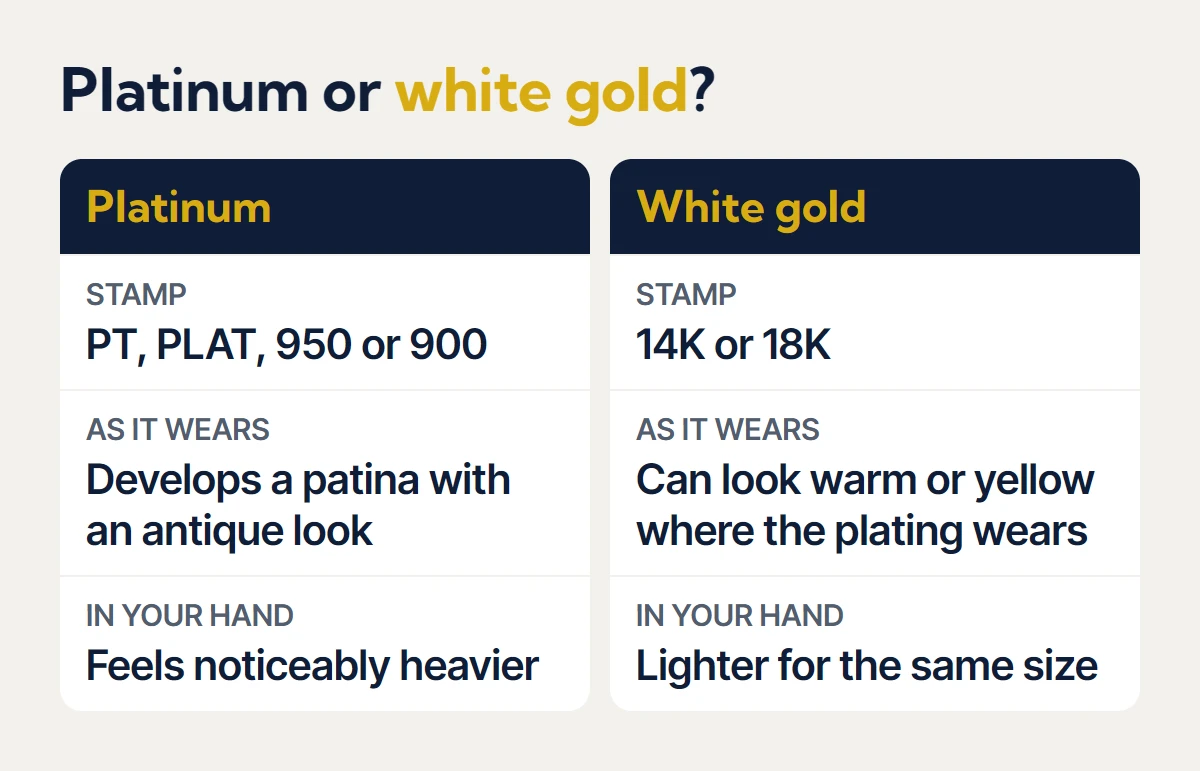
GIA describes white gold as gold mixed “with nickel or palladium, copper and zinc,” and notes that “white gold is often plated with the element rhodium.” In its guide to ring metals, GIA adds that “as the rhodium plating wears away, the ring may start to appear warm in color.” A white ring with a faint yellow or warm tone in worn spots is most likely white gold.
Platinum behaves differently. The same GIA guide says platinum “has a bright white finish without having to be plated,” and that “over time, platinum develops a patina that gives it a unique, antique look.” A less shiny, antique-looking finish with no yellow showing is consistent with platinum. But GIA also notes that some manufacturers rhodium plate platinum rings, so a bright finish alone proves nothing.
If you still have the receipt, read it. The FTC’s guides say it is unfair or deceptive “to fail to disclose a surface-layer application of rhodium on products marked or described as precious metal” (16 CFR 23.7), so the paperwork may mention plating.
The weight in your hand
Platinum is very dense. The National Institutes of Health’s PubChem database lists platinum at 21.46 grams per cubic centimeter, against 19.28 for gold and 10.50 for silver. 14K white gold is only 583 parts per thousand gold, and the metals that make up the rest, such as nickel, copper, zinc or palladium, are all listed in PubChem at 12 or less. So a platinum band usually feels noticeably heavier than a white gold band of the same size. Treat that as a hint only: a thick white gold ring can outweigh a thin platinum one.
How a Buyer Values a Platinum Ring
A platinum ring bought for its metal is valued the same basic way as gold, in three steps:
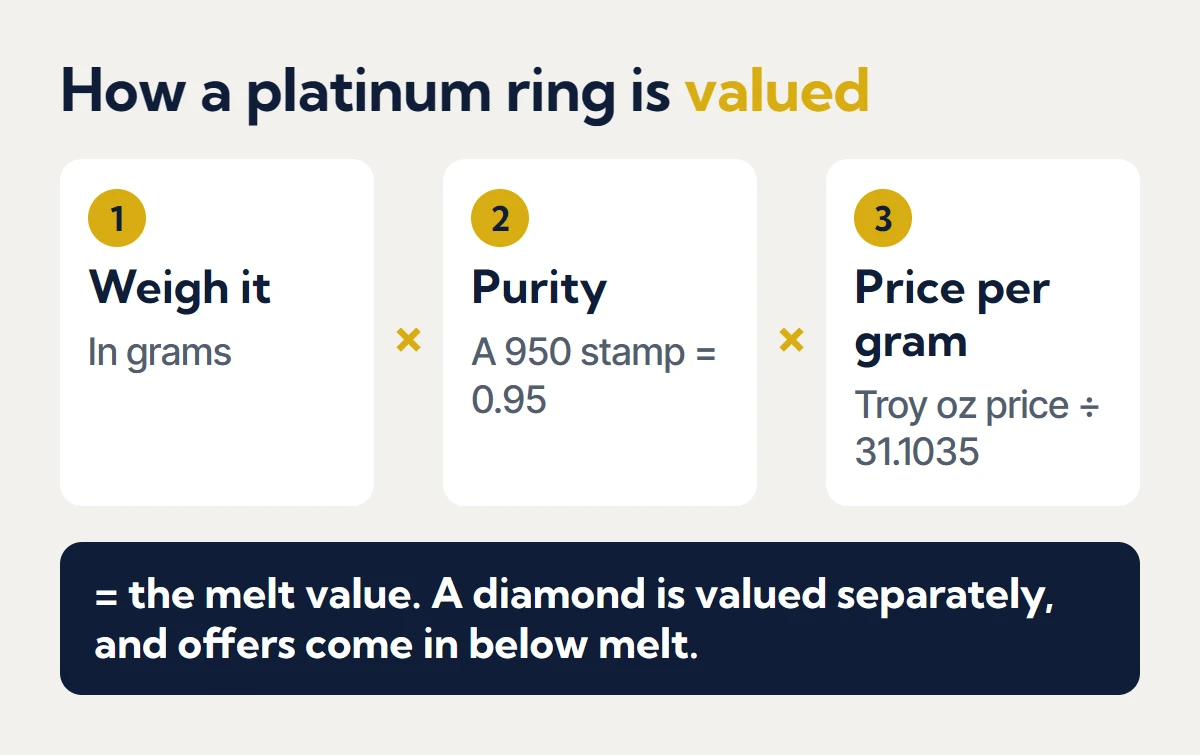
- Weight. The ring is weighed, usually in grams. Some buyers weigh in pennyweights (dwt), and the National Institute of Standards and Technology lists one pennyweight as 1.555 grams.
- Purity. The stamp and the test show how much of that weight is platinum. A 10-gram band stamped 950 holds about 9.5 grams of pure platinum.
- The platinum price that day. Platinum has its own daily price, separate from gold, quoted per troy ounce. NIST’s precious metal conversion sheet says to divide the price per troy ounce by 31.1034768 to get the price per gram.
Multiply the grams of pure platinum by the price per gram and you have the melt value. You can see the daily benchmark on the LBMA precious metal prices page by choosing Platinum in the Metal menu. The LBMA says prices on its website “are displayed with a delay until midnight following the setting of the prices each day,” so use it as a guide, not a live quote.
Any buyer’s offer will be below the melt value, because the metal still has to be refined and the buyer has costs to cover. Ask how an offer was worked out, and get more than one.
Diamonds and other stones
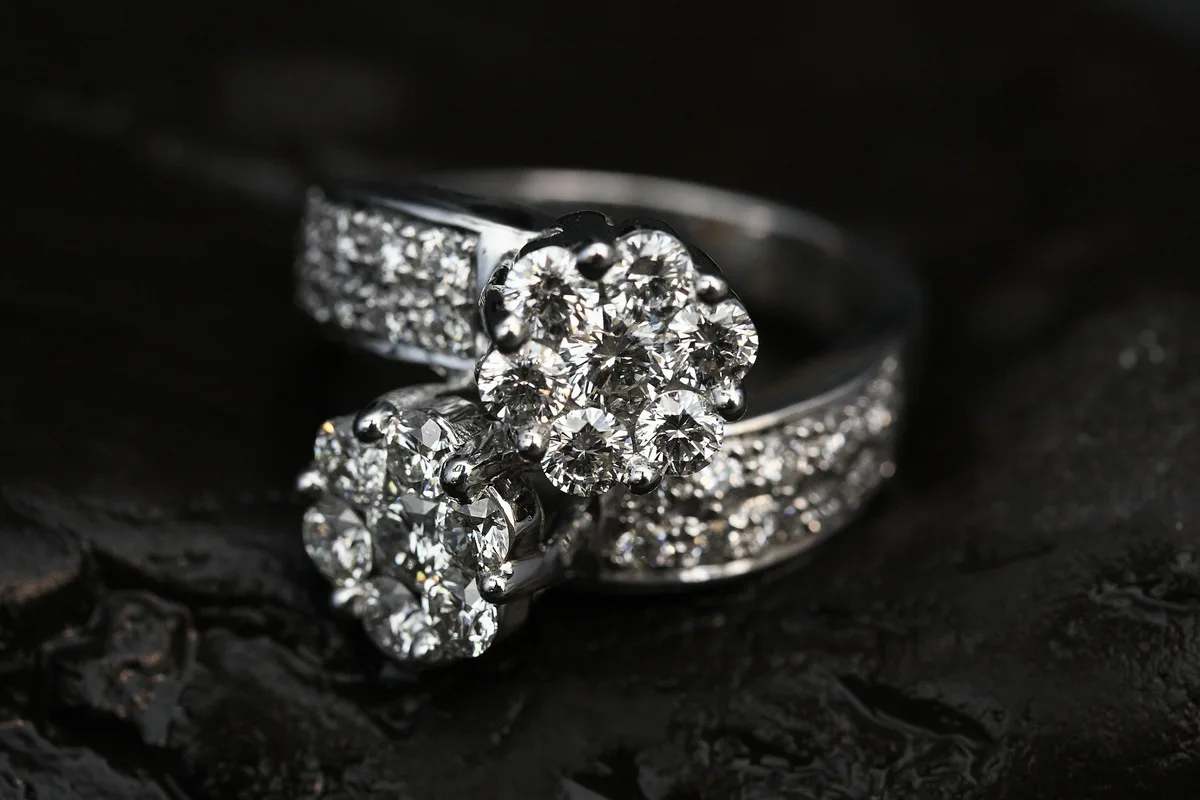
The stone is not counted in the platinum weight. A diamond is valued on its own: GIA describes diamonds by the 4Cs, clarity, color, cut and carat weight, and explains that “the value of a finished diamond is based on this combination.” A grading report helps the buyer confirm what the stone is. Ask how the stone is being valued, so you know what you are being paid for. For a valuable center stone, see our guide to pawning or selling a diamond.
Sell It or Pawn It?
Selling gives you the full purchase offer and suits a ring you are sure you will not want back.
A jewelry loan, also called a pawn loan, keeps the door open. As our jewelry loan page puts it, you use your jewelry as collateral, “receive cash immediately and reclaim your piece once the loan and applicable fees are repaid.” If you do not repay within the loan term, you can lose the ring, so borrow only what you expect to pay back. Our guide to how pawn loans work under Massachusetts law explains the rules.
A wedding or engagement ring can raise one more question: whether you are allowed to sell it yet. If you are going through a divorce, read our guide to selling a wedding ring after divorce first.
What to Bring
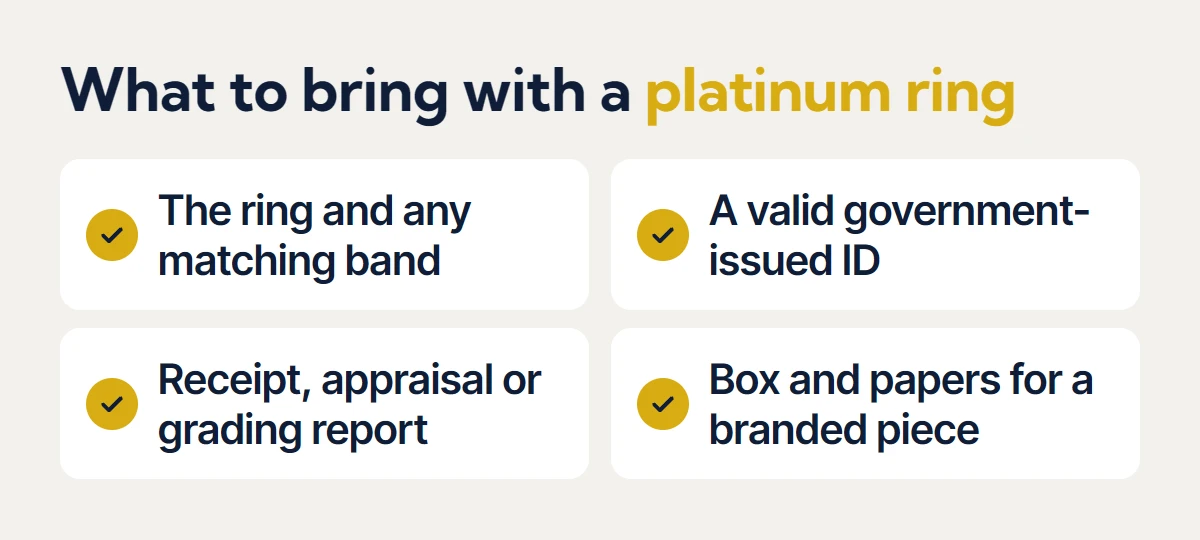
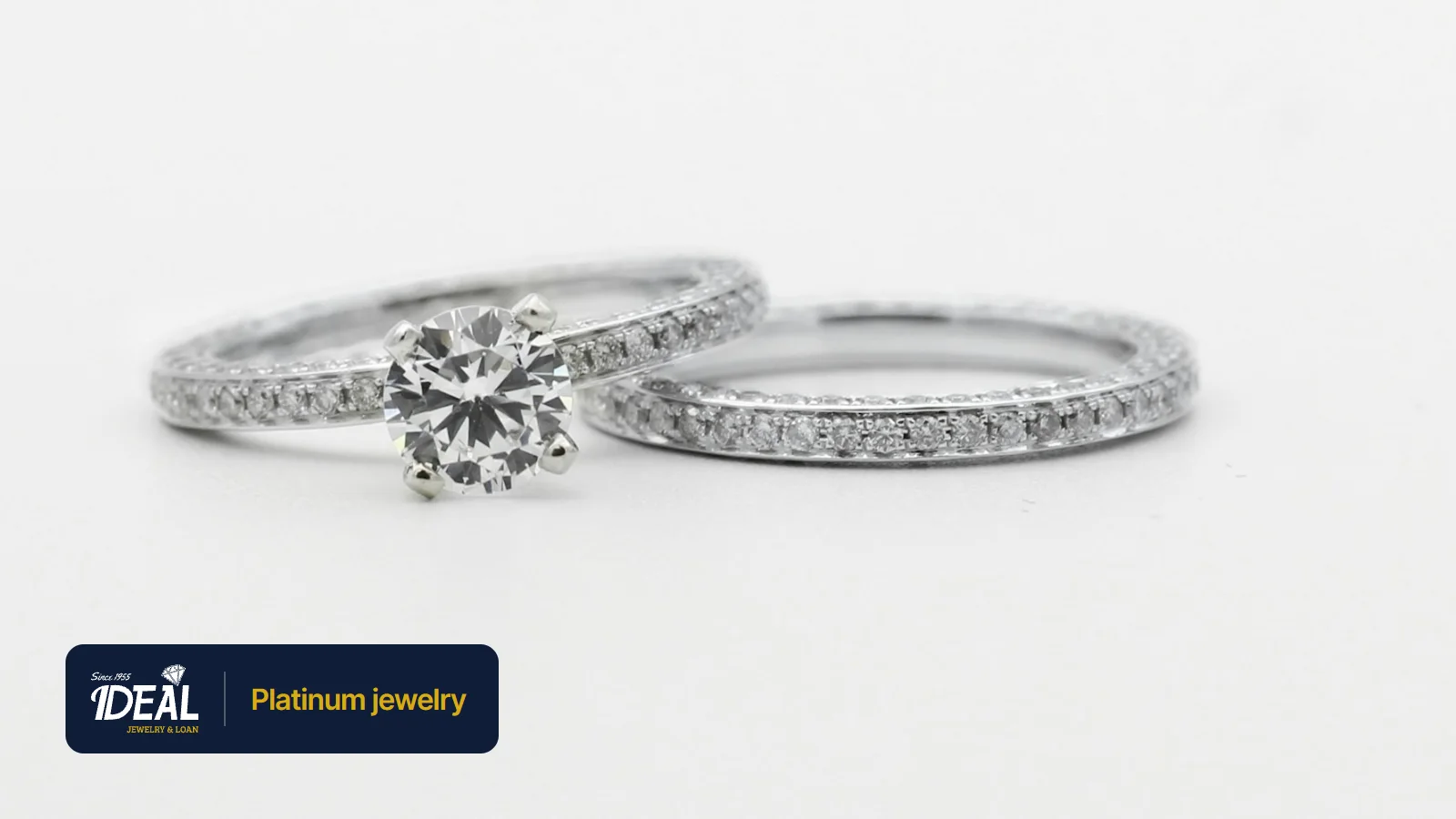
- The ring, and its matching band if you are deciding about both.
- A valid government-issued ID.
- Any receipt, appraisal or grading report. A receipt can show the metal and any plating, and a grading report identifies the diamond.
- The box and papers for a branded piece. Our diamond page notes that pieces from makers such as Tiffany and Cartier typically receive higher offers.
Selling a Platinum Ring at Our Brockton Shop
Ideal Jewelry and Loan has bought precious metals and made pawn loans in downtown Brockton since 1955, and our shop is at 242 Main St. Here is what to expect if you bring in a platinum ring or band:
- We have more than 70 years of experience buying silver, gold, platinum and diamonds, and we buy precious metals in any condition.
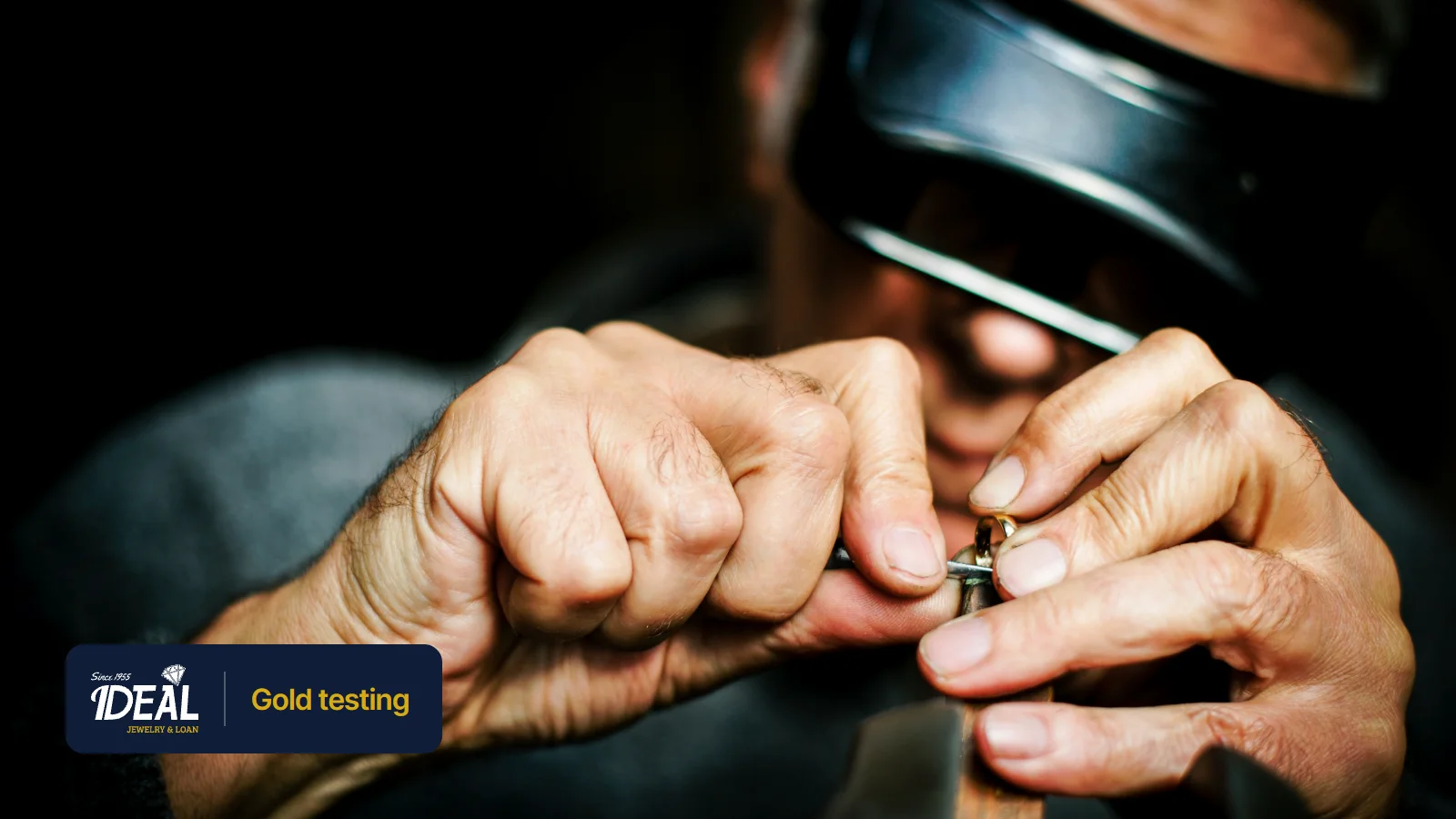
- Items are tested on-site, and the appraisal is free with no obligation to sell.
- We evaluate diamonds on the 4Cs, and the evaluation is free.
- If you would rather keep the option of getting the ring back, ask about a jewelry loan, with no credit check. Diamond jewelry is accepted for loans; for a plain platinum band, call and ask first.
- We walk you through both selling and pawning before you decide. To ask how we price a particular alloy, such as platinum with cobalt, call before you come in.
No appointment is needed. We are open Monday through Friday 9am to 5pm and Saturday 10am to 4pm. Call us at 1-508-583-8448 or send us a message if you have a question before you come in.
Frequently Asked Questions
Do pawn shops buy platinum rings?
Some do and some do not, so call ahead. A shop that buys platinum bases its offer on the ring’s platinum content and that day’s price, with any diamond valued separately. Ideal Jewelry and Loan has bought platinum, along with gold, silver and diamonds, for more than 70 years.
Can you pawn platinum?
It depends on the shop. A pawn loan is based on what the piece is worth, and platinum has metal value with or without a stone, but policies differ, so ask first. At our shop, diamond jewelry is accepted for loans; for a plain platinum band, call 1-508-583-8448.
Platinum ring vs white gold: how can I tell?
Start with the stamp: PT, PLAT, or a number such as 950 or 900 with Pt, means platinum, while 14K or 18K means gold. Without a clear stamp, a warm or yellowish tone where the plating has worn points to white gold, and a heavier feel points to platinum. A buyer’s test settles it.
What is platinum ring patina?
It is the finish platinum develops over time as it is worn. GIA says the patina gives platinum “a unique, antique look” and that it can be polished away if you prefer a shinier appearance. Patina is a surface finish, so it does not change how much platinum is in the ring.
How much is platinum worth per gram?
It changes every trading day. Divide the day’s price per troy ounce by 31.1034768 to get the price per gram of pure platinum, then multiply by your ring’s purity: 0.95 for a 950 stamp or 0.90 for 900. A buyer’s offer will be below that figure to cover refining.
How much is platinum worth compared to gold?
Less than many people expect. GIA noted in 2025 that platinum’s price had fallen in recent years while gold’s had risen, and that platinum then cost less than gold. The LBMA benchmark prices for October 19, 2026 still showed platinum at well under half the price of gold per troy ounce. The two prices move separately, so compare them on the day you sell.