
A pawn loan is one of the few types of borrowing that does not touch your credit score, does not require paperwork about your income, and does not involve a lender calling you if payment is late. Understanding why requires a quick look at how Massachusetts actually regulates the process.
Key Takeaways
- Massachusetts General Laws Chapter 140, Sections 70 to 85 gives cities and towns authority to license pawnbrokers, subject to Division of Banks approval.
- The Division of Banks has not approved pawnbroker interest rates above 36 percent annually for loans greater than 25 dollars.
- Pawn loans are secured by the item itself, so there is no credit check and no credit reporting involved.
- If a loan is not repaid, the item becomes available for sale. There is no additional debt or collection process.
The Legal Basis for Pawn Loans in Massachusetts
Pawnbroking in Massachusetts is licensed at the local level under authority granted by Massachusetts General Laws Chapter 140, Sections 70 through 85. Cities and towns set local rules within that framework, but any interest rate rule still requires approval from the Commonwealth’s Division of Banks before it can be enforced. This two layer structure means a pawnbroker operating in Brockton is subject to both state oversight and local licensing requirements simultaneously.
Interest Rates Are Capped by the State
One of the most important protections in Massachusetts pawn law is the interest rate cap. According to the Division of Banks, no pawnbroker interest rate above 36 percent annually has been approved for loan amounts greater than 25 dollars. This cap exists specifically to prevent the kind of runaway interest structures seen in some unregulated lending markets. When you receive a pawn loan quote in Massachusetts, that rate has to fall within an approved structure, not an arbitrary number set at the counter.
Why Pawn Loans Do Not Affect Your Credit
A pawn loan is fundamentally different from a personal loan or credit card because it is secured entirely by the item you bring in. The pawnbroker is not extending credit based on your income or credit history. That is why there is no credit check at the counter and no reporting to credit bureaus, regardless of whether the loan is repaid on time or not repaid at all.
What Happens If You Cannot Repay
This is the detail that surprises most first time borrowers. If a pawn loan is not repaid within the required period, you do not owe additional money and you are not sent to collections. The item you pawned simply becomes available for resale to recover the loan amount. Your only loss is the item itself, not your credit standing or your bank account. That structure is intentional. It is what makes a pawn loan fundamentally lower risk than most other forms of short-term borrowing.
Getting a Pawn Loan in Brockton
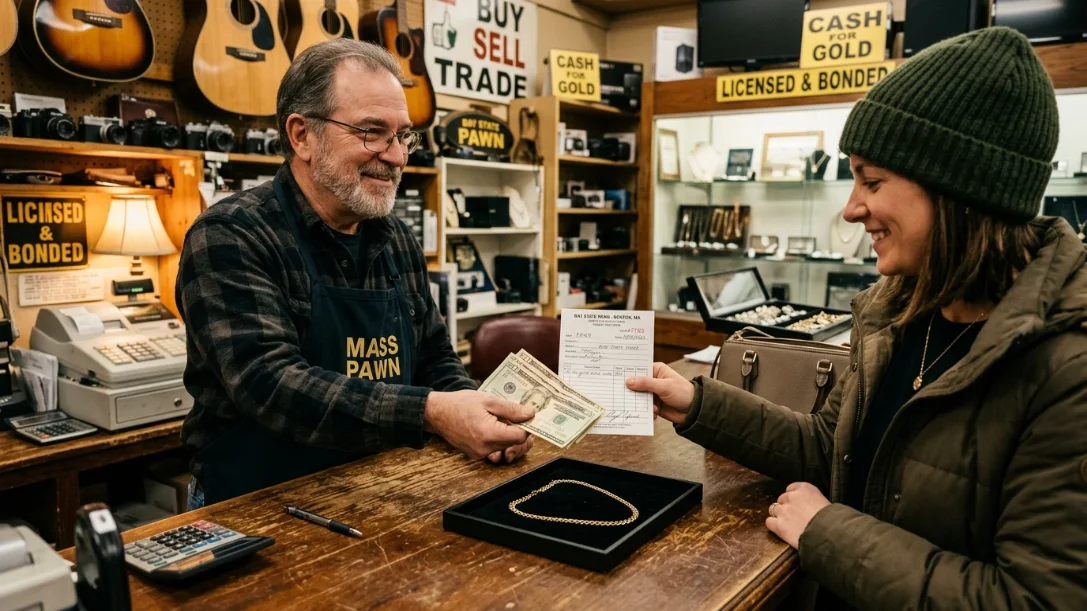
Ideal Jewelry & Loan has issued pawn loans under these exact state and local rules since 1955. Every loan comes with a clear, written ticket showing the loan amount, the interest rate, and the redemption period, so there is never confusion about the terms you agreed to.
Frequently Asked Questions
Is a pawn loan the same as selling an item outright? No. A pawn loan lets you borrow against an item’s value while keeping ownership, and you can reclaim the item by repaying the loan. Selling transfers ownership immediately in exchange for a lump sum.
How is my loan amount determined? Loan amounts are based on the appraised value of your item, factoring in metal content, condition, brand, and current market demand at the time of the transaction.
Do I need good credit to get a pawn loan? No. Pawn loans require no credit check whatsoever, since the loan is fully secured by the item itself rather than your credit history.
Can I pay off my loan early? Yes. Most pawn loans can be repaid at any point before the redemption period ends, and doing so returns your item to you immediately.
Call us at 1-508-583-8448 or visit us at 242 Main St., Brockton, MA 02301.
Follow Ideal Jewelry and Loan on Facebook.