

Do You Pay Taxes When You Sell Gold or Silver?
Yes, if you sell gold or silver for more than you paid, the profit is a taxable capital gain. The IRS classifies physical precious metals as collectibles, which caps the long-term capital gains rate at 28%, higher than the 15% or 20% that typically applies to stocks.
This article is general information, not tax advice. Rules change and individual situations differ, so consult a CPA or tax professional about your specific circumstances.
Key Takeaways
- The IRS treats physical gold and silver as collectibles, with a long-term capital gains rate capped at 28%.
- You owe tax on gains whether or not the dealer files a Form 1099-B. Dealer reporting and your reporting obligation are separate things.
- Dealers file Form 1099-B only when a sale meets specific quantity and purity thresholds.
- Cost basis is what you originally paid, including premiums, so keeping receipts matters more than most sellers realize.
- Pawning an item is a loan, not a sale, so it is not a taxable event.
How Much Tax Do You Pay on Gold and Silver Sales?
The rate depends on how long you held the metal. If you held it for more than one year, the gain is long-term and taxed at the collectibles rate, which is your ordinary income rate up to a maximum of 28%. If you held it a year or less, the gain is short-term and taxed as ordinary income.
Because precious metals are categorized as collectibles, the long-term capital gains rate that applies to assets held more than one year is capped at 28%, which is significantly higher than the 15% or 20% rates applied to traditional equities. For taxpayers in lower brackets, the rate is their marginal income tax rate rather than the full 28% ceiling.
This treatment extends further than many people expect. Popular gold and silver exchange-traded funds that hold physical metal are generally taxed the same way as the bullion itself, at the higher collectibles rate.
When Does a Dealer Report Your Sale to the IRS?
Dealers file Form 1099-B only when a transaction meets specific thresholds set by IRS guidance. The dealer must report the transaction using Form 1099-B and provide you a copy, but not all precious metals sales are reportable, since the IRS only requires reporting for sales meeting certain quantity and purity requirements.
The commonly cited thresholds for bars and rounds are: gold bars and rounds require a purity of at least .995 with a total quantity of 1 kilo (32.15 troy ounces) or more, and silver requires a purity of at least .999 with a minimum of 1,000 troy ounces; palladium and platinum thresholds are 100 and 25 troy ounces respectively at .9995 purity. For coins, reportable silver sales include 90 percent silver U.S. coins with a face value over $1,000, while certain gold coins are reportable in specified quantities.
Notably, fractional gold coins, Gold and Silver American Eagles, and certain other coins are exempt from 1099-B reporting. Most ordinary retail sellers never reach a 1099-B threshold at all.
There is also a separate cash-reporting rule. Form 8300 is used to report cash payments of $10,000 or more, and dealers must file it for any single transaction at that level or for multiple transactions within 24 hours that add up to it.
Do You Still Owe Tax If You Don’t Get a 1099-B?
Yes. This is the single most common and most costly misunderstanding. You are legally required to report gold sales as capital gains on your tax return even if you do not receive a Form 1099-B from your dealer, and assuming that the absence of a 1099-B means the transaction is tax-free is incorrect.
The reporting rules govern what the dealer tells the IRS, not what you owe. You report the sale yourself on IRS Form 8949 and Schedule D as part of your Form 1040 filing, and the responsibility to report and pay the tax lies with the seller.
What Is Cost Basis and Why Does It Matter?
Cost basis is what you originally paid for the metal, including any premium over spot and any shipping costs. Your taxable gain is the sale price minus that basis, so a higher documented basis means a lower taxable gain.
The most common mistake precious metals owners make at tax time is being unable to prove cost basis because they bought coins years ago in cash. Without documentation, you may struggle to substantiate what you paid. A simple spreadsheet with one row per purchase recording date, product, ounces, and total cost paid is enough.
If you inherited the metal, the basis is generally the value on the date of the previous owner’s death rather than what they originally paid. Documenting that date-of-death value immediately is important.
Why the One-Year Holding Period Matters
The line between short-term and long-term is exactly one year, and crossing it changes your rate meaningfully. Sell at eleven months and the entire gain is taxed as ordinary income, which for higher earners can exceed the 28% collectibles ceiling. Sell at thirteen months and the long-term collectibles treatment applies.
This is worth knowing if you are close to the line and not under pressure to sell immediately. It is also worth knowing that the holding period runs from the date you acquired the metal, not the date you decided to sell it, so purchase records serve double duty by establishing both your basis and your holding period.
For inherited metal the rules work differently and are generally more favorable, since inherited assets typically receive long-term treatment regardless of how long you personally held them. Confirm the specifics with a tax professional, since inheritance situations vary.
Records Worth Keeping
Build a simple file, digital or physical, containing:
- Purchase receipts or invoices showing date, item, quantity, and total paid
- Any premium paid over spot, since it is part of your basis
- Shipping or insurance costs tied to the purchase
- For inherited metal, documentation of date-of-death value
- Sale receipts and any Form 1099-B you receive
- A running spreadsheet if you buy in multiple transactions over time
The effort is small compared to the alternative of reconstructing years of purchases under deadline pressure, or paying tax on a gain larger than you actually made because you could not prove what you originally paid.
Is Pawning Gold Taxable?
No. A pawn loan is a loan secured by your item, not a sale, so no ownership transfer occurs and no capital gain is realized. You receive loan proceeds, which are not income.
This distinction matters if you are weighing options. If you expect a large taxable gain on a sale and you only need short-term cash, a loan against the item avoids triggering a taxable event entirely, though you will pay interest and fees instead. Our guide on how pawn loans work covers the mechanics.
If you later forfeit the item rather than repaying, consult a tax professional, since the treatment of a forfeiture can be more complex than a straightforward loan.
What About Sales Tax When Buying?
Sales tax is a separate matter from capital gains, and it is governed by state law rather than federal. Many states exempt investment-grade bullion entirely, some exempt purchases over a threshold often around $1,000 to $1,500, and a few tax all precious metal purchases at the full rate.
Massachusetts-specific bullion sales tax treatment should be verified with the Massachusetts Department of Revenue or your tax professional, since exemption thresholds can change.
Practical Steps Before You Sell
- Locate your purchase records. Receipts, invoices, or statements establishing what you paid.
- Confirm your holding period. More than one year qualifies for the long-term collectibles rate.
- Ask the dealer whether your sale is reportable. If you are selling something like a 100 oz silver bar, ask before the transaction.
- Keep the paperwork from the sale itself, including any 1099-B you receive.
- Talk to a CPA if the gain is substantial or your situation is complicated.
Selling Gold or Silver at Our Brockton Shop
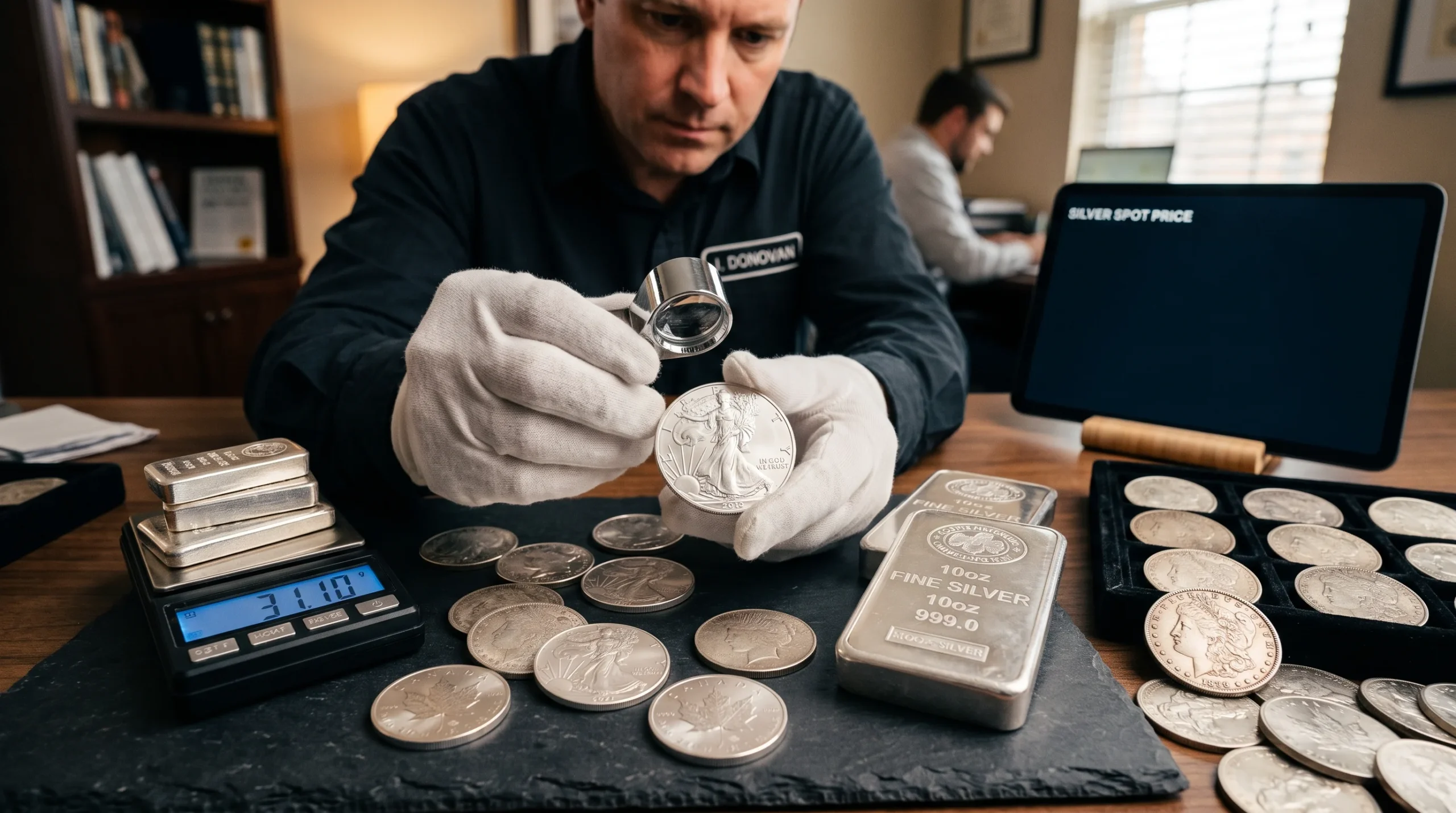
Ideal Jewelry and Loan has bought and appraised gold, silver, coins, and jewelry at 242 Main St. in Brockton since 1955. We check prices against current market values daily, testing for coin and bullion items is free, and we will show you the weight, purity, and the day’s spot price behind any offer before you decide.
We are open Monday through Friday 9am to 5pm and Saturday 10am to 4pm, and you can reach us at 1-508-583-8448.
What we cannot do is tell you what you owe on your tax return, and no metals buyer or pawnbroker can. Your cost basis, holding period, and filing situation are specific to you, and a CPA or tax professional is the right person to work through them. What we can do is give you clear documentation of the sale so that conversation is straightforward.
Frequently Asked Questions
Do I have to report selling gold coins on my taxes?
Yes. Any gain from selling gold coins is a reportable capital gain, filed on Form 8949 and Schedule D, regardless of whether the dealer issues you a Form 1099-B.
How much gold can I sell without the dealer reporting it?
It depends on the product. Gold bars and rounds become reportable at 1 kilo (32.15 troy ounces) or more at .995 purity, while American Gold Eagles and fractional gold coins are exempt from 1099-B reporting. Dealer reporting does not change your own obligation to report gains.
What tax rate applies to selling silver?
The same collectibles treatment as gold. Held more than a year, the long-term rate is your ordinary rate capped at 28%. Held a year or less, it is taxed as ordinary income.
Do pawn shops report sales to the IRS?
A pawnbroker buying reportable quantities of precious metals is subject to the same Form 1099-B rules as other dealers, and Form 8300 applies to cash payments of $10,000 or more. A pawn loan, by contrast, is not a sale and is not reported as one.
Is a pawn loan taxable income?
No. Loan proceeds are not income because you are borrowing against an item you still own, not selling it.
What if I sell at a loss?
If a sale results in a loss or no profit, no capital gains tax applies. Whether you can deduct a loss on personal-use property is a question for your tax professional.