

Most people find out whether a piece is real gold at the worst moment: when they are already standing at a counter hoping to sell it. You can learn a lot before then. A few minutes with good light and a magnifying glass will usually tell you whether a piece is likely to be solid gold, gold-filled, plated, or not gold at all.
This guide explains what the stamps mean, which home checks are useful, which ones mislead, and how a buyer actually confirms what a piece is made of.
Start With the Stamp
Look on the inside of rings, on clasps and on the small tag near the clasp of chains and bracelets. Gold jewelry sold in the United States is usually marked with its karat, written either as a karat number or as a three-digit fineness number.
| Stamp | Meaning | Gold content |
|---|---|---|
| 10K or 417 | 10 karat | 41.7% |
| 14K or 585 | 14 karat | 58.3% |
| 18K or 750 | 18 karat | 75% |
| 22K or 916 | 22 karat | 91.7% |
| 24K or 999 | Fine gold | Essentially pure |
The percentages follow from the karat system itself: pure gold is 24 karat, so 14 karat means 14 parts gold in 24.
Treat a stamp as a strong clue, not proof. Stamps wear away on old rings, can be removed when a ring is resized, and are sometimes missing on handmade or imported pieces. A stamp can also simply be wrong. An unmarked piece is not automatically fake, and a marked piece still needs testing before anyone pays for it as gold.
Solid Gold, Gold-Filled, Plated or Vermeil
This is where most confusion comes from, because all four can look the same on the outside. The Federal Trade Commission’s Guides for the Jewelry Industry set out how each should be described, and the wording on a stamp tells you a great deal once you know it.
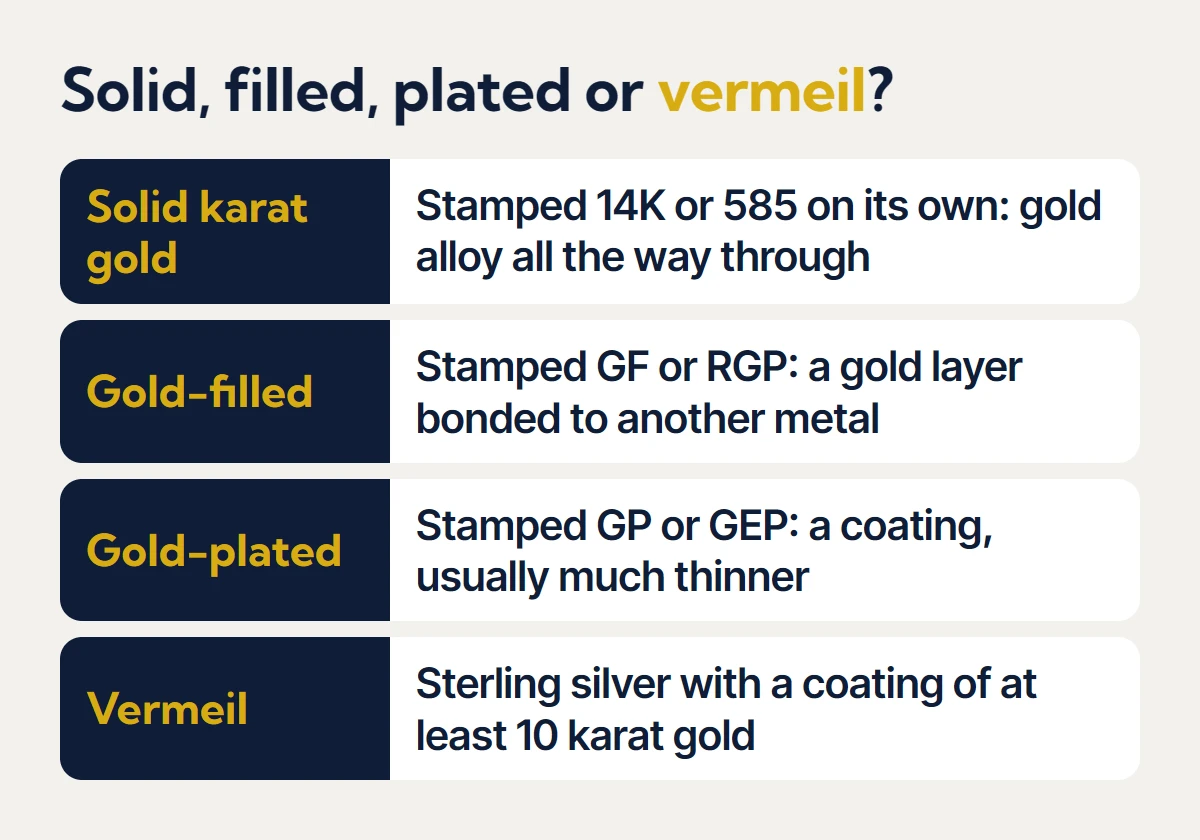
- Solid karat gold. Under the guides, the word “gold” on a piece made of a gold alloy should be preceded by its karat, for example “14 Karat Gold” or “14K.” A stamp that reads 14K or 585 on its own describes gold alloy all the way through.
- Gold-filled. Terms like “Gold Filled,” “Rolled Gold Plate” or “Gold Overlay,” or their abbreviations such as GF and RGP, describe a layer of gold alloy bonded to another metal. The karat shown is the karat of that layer, so 14K GF is not solid 14K gold.
- Gold-plated. “Gold Plate,” “Gold Electroplate” and abbreviations such as GP and GEP describe a coating of gold alloy over another metal, usually much thinner than gold-filled.
- Vermeil. The same guides describe vermeil as sterling silver coated with gold of at least 10 karat. Underneath the gold color, it is silver.
Two more terms are worth knowing. “Gold tone” describes a color, not a metal. And the guides say a gold piece with a hollow center should be described that way, because hollow chains and hoops can look heavy while holding much less gold than their size suggests.
Gold-Colored but Stamped 925, and White Metals
Two situations catch a lot of people out.
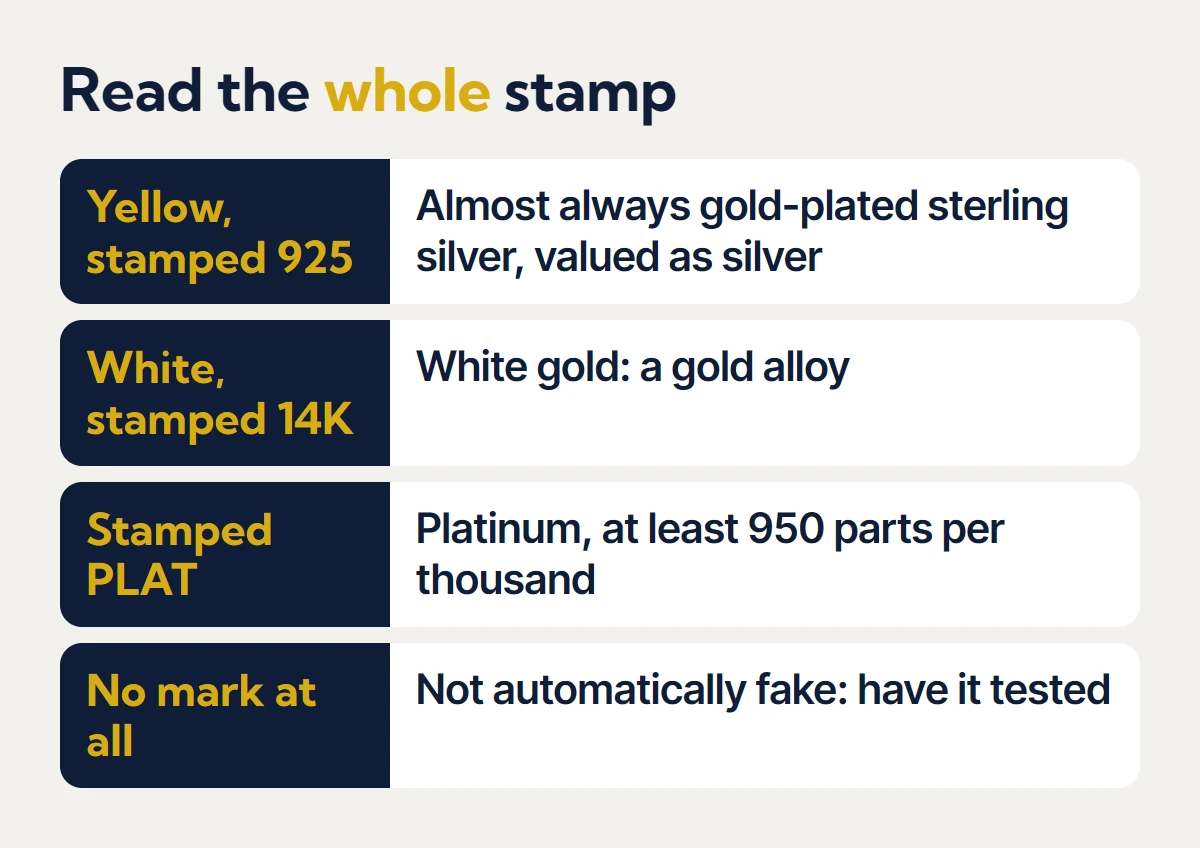
A yellow chain stamped 925. The number 925 means sterling silver, which the FTC guides reserve for metal that is at least 925 parts per thousand pure silver. A gold-colored piece with only a 925 mark is almost always gold-plated sterling silver. It has real value, but as silver, not as gold.
White pieces. White gold is a gold alloy mixed with white metals and is usually stamped with its karat, just like yellow gold, so a white ring marked 14K is gold. Platinum is a different metal: under the same guides, a piece described simply as “Platinum,” or with an abbreviation such as PLAT, should be at least 950 parts per thousand pure platinum. A white piece stamped 925 is sterling silver, and a white piece with no mark at all could be any of these, or stainless steel.
Home Checks: What They Can and Cannot Tell You
None of these checks proves that something is gold. Used together, they help you sort a drawer of jewelry before you take it anywhere.
The magnet check
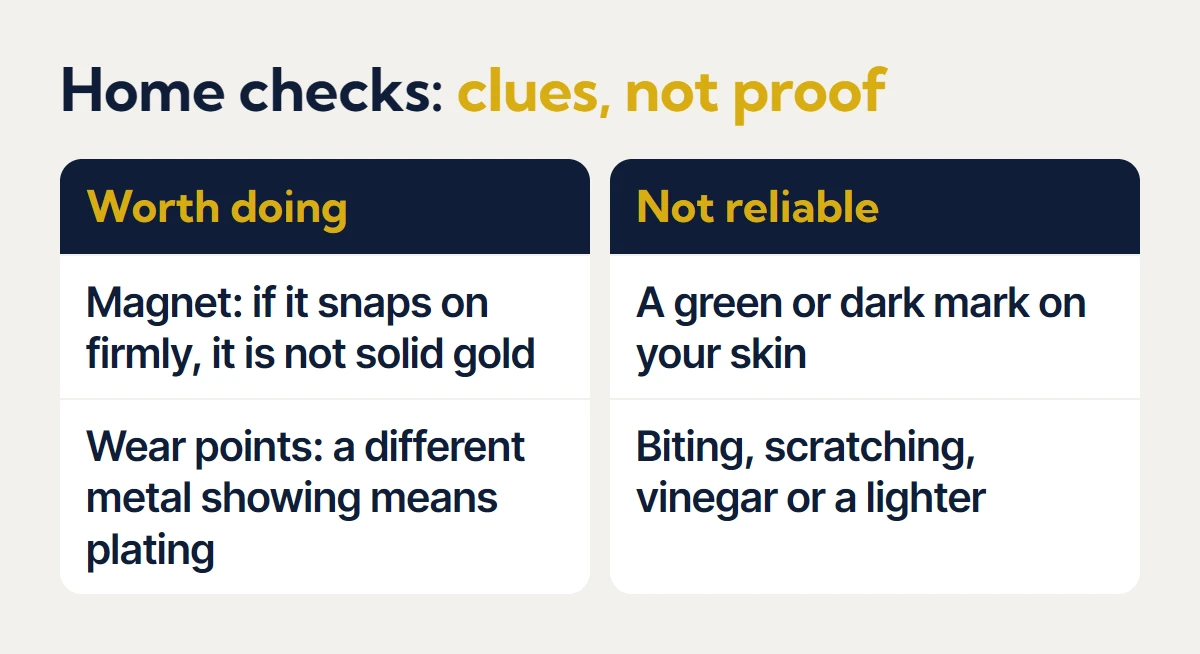
Gold itself is not magnetic. If a ring or chain snaps firmly to a strong magnet, it is not solid gold. Test the main body of the piece, not the clasp, because clasps often contain a small steel spring. A piece that ignores the magnet is not proven to be gold either, since copper, brass and silver are not magnetic.
Look at the wear points
Check the edges and high points that rub against skin and clothes: the bottom of a ring band, the links of a bracelet, the backs of earrings. On plated pieces, wear often exposes a different colored metal underneath. Solid gold keeps the same color all the way through, even where it is worn.
Skin discoloration
A green or dark mark on the skin is a common worry, but it is not reliable either way. Base metals in plated jewelry can cause it, and so can the copper and silver mixed into solid karat gold, depending on skin chemistry, soaps and lotions.
Tests to skip
Biting, scratching, vinegar soaks and holding a lighter to jewelry are popular online, but none of them reliably separates solid gold from plated or filled gold. Heat can also damage stones and soldered joints, and scratching can leave permanent marks on a piece that may turn out to be valuable.
How a Buyer Confirms What It Is
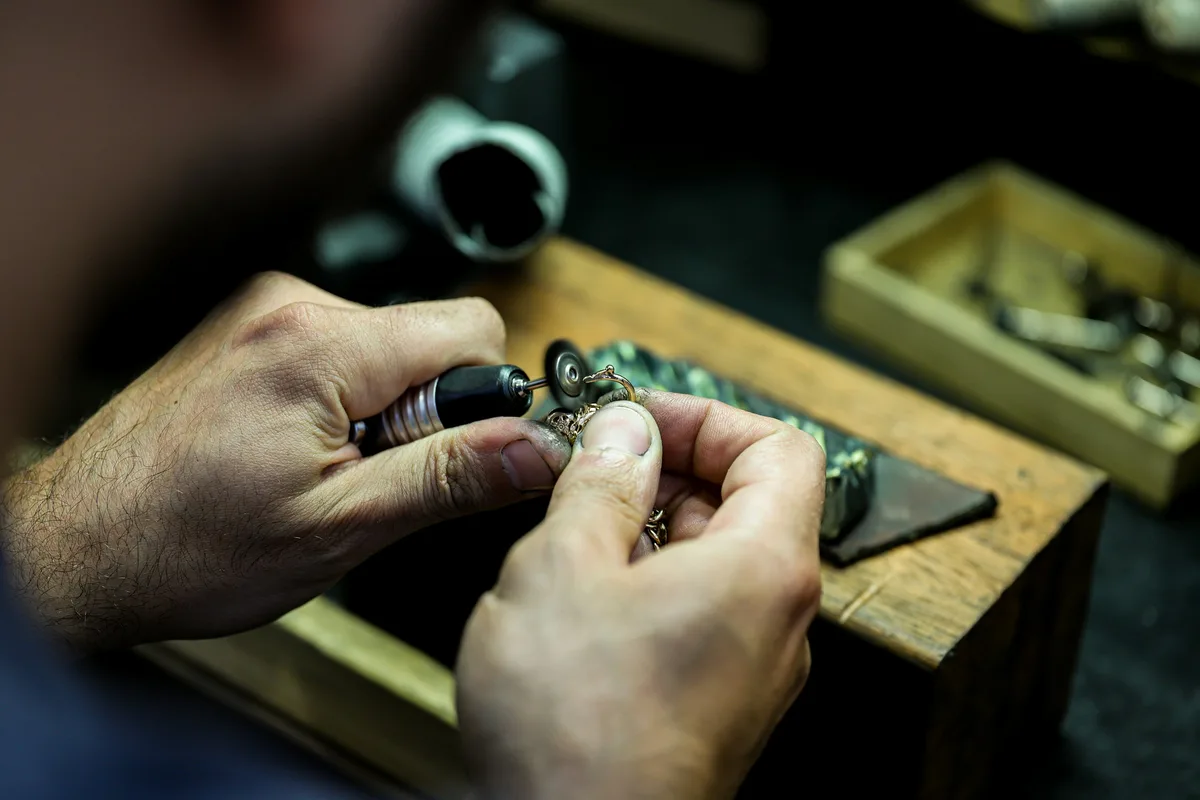
A gold buyer does not rely on the stamp alone. Common professional methods include:
- Acid testing, where a small streak from the piece on a testing stone is checked with acids of different strengths to estimate the karat.
- Electronic gold testers, which read the metal’s response through a probe.
- X-ray fluorescence (XRF) analyzers, which measure the metals present without marking the piece.
You are entitled to ask how a piece was tested and what the result was. A buyer who explains the weight, the karat and the price behind an offer is easier to trust than one who just names a number.
Why It Matters When You Sell
Gold is bought by weight and purity, so the difference between solid, filled and plated is the difference between a real payout and very little. A heavy-looking gold-plated bracelet may be worth less than a thin solid 14K chain.
A few practical tips before you sell:
- Sort by stamp. Group 10K, 14K and 18K pieces separately, and keep anything marked GF, GP or 925 apart.
- Do not throw away unmarked pieces. Let a buyer test them; worn or missing stamps are common on older jewelry.
- Know roughly what to expect. Our gold price per gram calculator gives a rough idea once you know the weight and karat.
- Check your silver too. Many drawers mix gold with silver pieces; our guide to sterling versus silver-plated covers the silver side.
Have It Tested Free at Our Brockton Shop
Ideal Jewelry and Loan has bought gold in downtown Brockton since 1955, and our shop is at 242 Main St. If you are not sure what you have, bring it in:
- Every item is tested on-site and priced against the current daily gold rate.
- Our appraisal is free, and there is no obligation to sell.
- We buy gold in every karat and in any condition, including broken and scrap pieces.
No appointment is needed. We are open Monday through Friday 9am to 5pm and Saturday 10am to 4pm. Call us at 1-508-583-8448 or send us a message with any questions.
Frequently Asked Questions
What does 14K GF mean on jewelry?
It means gold-filled: a layer of 14 karat gold alloy bonded to another metal. It is not solid 14K gold and contains much less gold than a solid piece of the same size.
Is jewelry without a stamp fake?
Not necessarily. Stamps wear off, are removed during resizing, and are missing on some handmade and imported pieces. The only way to know is to have the metal tested.
Does real gold turn your skin green?
It can. Solid karat gold contains other metals such as copper and silver, which can react with skin, soap or lotion. Discoloration is not a reliable sign either way.
Is gold vermeil worth anything to a gold buyer?
Vermeil is sterling silver with a gold coating, so it is usually valued as silver. The gold layer is too thin to add much value.
Will testing damage my jewelry?
It depends on the method. Electronic and XRF testing do not mark the piece. Acid testing uses a small streak on a testing stone. Ask the buyer which method they use before they start.